
Full-Spectrum, Broad-Spectrum or Isolate: What Changes for Your Next Order After the Ban?

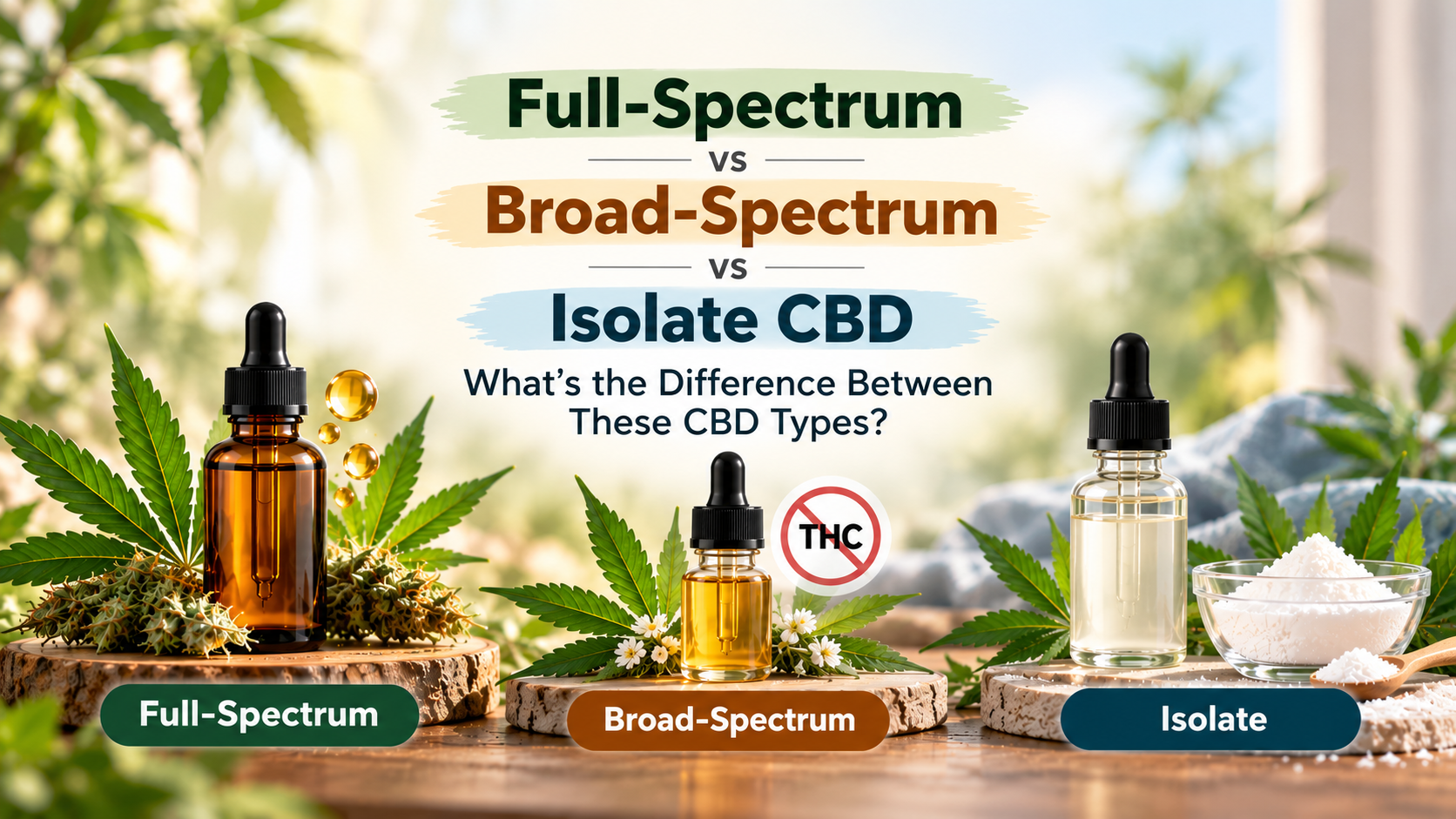
Quick answer: Full-spectrum CBD keeps trace THC, broad-spectrum has THC removed, and isolate is pure CBD. When the federal cap of 0.4 mg total THC per container takes effect on December 11, 2026, most full-spectrum products won’t fit. Broad-spectrum and isolate products that test non-detect for THC are the likeliest to stay on shelves.
These three labels have been around for years, but until now they mostly came down to personal preference. The new federal hemp definition turns them into a legal question. If you reorder the same CBD product every month, the type on the label may decide whether it’s still available next year.
What’s the difference between full-spectrum, broad-spectrum and isolate CBD?
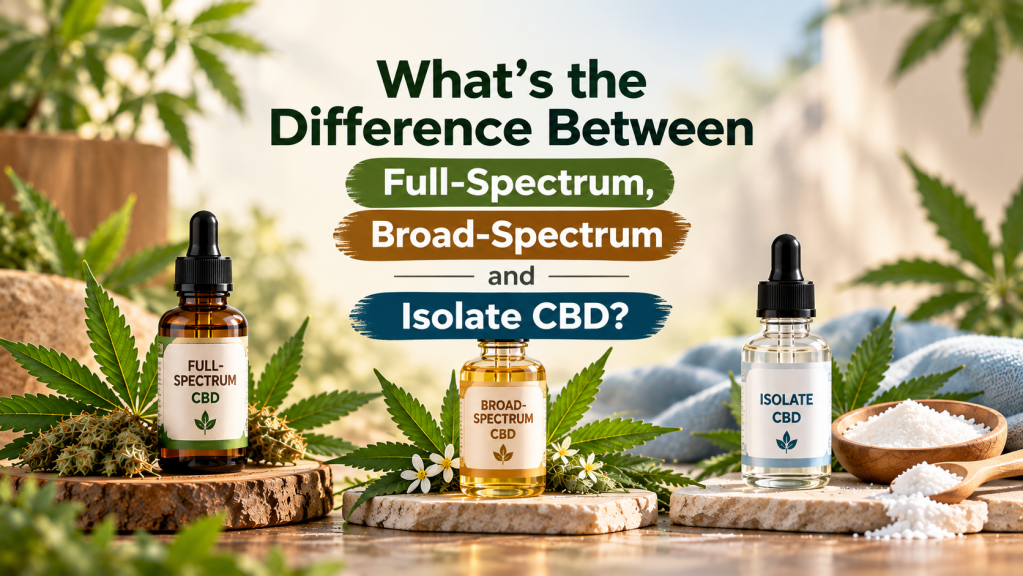
The difference is what stays in the extract besides cannabidiol (CBD). Full-spectrum keeps almost everything from the hemp plant, broad-spectrum keeps most of it minus THC, and isolate keeps only CBD.
Here’s how each one is made:
- Full-spectrum: The whole-plant extract. It includes CBD, minor cannabinoids such as CBG, CBN and CBC, terpenes, and a small amount of delta-9 THC. Under the 2018 Farm Bill, that THC had to stay at or below 0.3% by dry weight.
- Broad-spectrum: A full-spectrum extract that goes through an extra step to strip out THC. The goal is a THC reading of “ND” (non-detect) on the lab report, while other cannabinoids and terpenes stay in.
- Isolate: CBD refined until nothing else is left, usually a white crystalline powder at 99% purity or higher. It has no terpenes, no other cannabinoids and no THC.
| Full-spectrum | Broad-spectrum | Isolate | |
|---|---|---|---|
| What’s inside | CBD, minor cannabinoids, terpenes, THC | CBD, minor cannabinoids, terpenes | CBD only |
| THC traces | Yes, by design | Should be non-detect | None |
| Flavor and aroma | Earthy, plant-like | Similar, sometimes milder | Neutral |
| Federal status after Dec 11, 2026 (as written) | Most will exceed 0.4 mg per container | Likely fits, if every batch tests non-detect | Likely fits, if testing confirms no THC |
That last row reflects the law as of October 2026. It isn’t a legal guarantee, and state rules can be stricter.
Why does the 0.4 mg cap hit full-spectrum CBD hardest?
Because full-spectrum is the only type that’s supposed to contain THC, and the new cap leaves almost no room for it. The limit is 0.4 mg of total THC for the whole container, not per serving.
The math shows how big the gap is. A 30-gram bottle at the old 0.3% delta-9 limit could legally hold about 90 mg of THC (30 g × 0.003 = 0.09 g). Under the new cap, that same bottle can hold 0.4 mg. That’s roughly 225 times less.
To stay under 0.4 mg in a 30-gram bottle, THC would have to sit around 0.0013% by weight. Very few whole-plant extracts can hit that without removing the THC, at which point the product is broad-spectrum.
The cap comes from the hemp definition Congress passed in November 2025. A funding law signed September 2, 2026 moved it from November 12 to December 11, 2026. Frier Levitt’s overview of the federal hemp redefinition covers the legal text.
Will broad-spectrum and isolate CBD still be legal after December 11, 2026?
They’re the types most likely to stay federally compliant, as long as testing shows total THC under 0.4 mg per container. That’s why many brands are already moving their lines toward THC-free CBD.
There are a few catches to keep in mind.
“Non-detect” isn’t the same as zero. It means the THC level was below what that lab’s equipment can measure. A sensitive lab might still find a trace, so the number on each batch’s COA matters more than the word on the front of the box.
The rules also count THCA, not only delta-9. Under the new total THC standard, THCA is added in, so a broad-spectrum product needs both to come back non-detect or very low.
State law adds its own layer. Texas already applies a 0.3% total THC limit that counts THCA, under rules from the Texas Department of State Health Services, and buyers must be 21 or older with ID. Texas has also banned vape products that contain cannabinoids since September 1, 2025, no matter which CBD type is inside.
How can you tell which CBD type you’re buying?
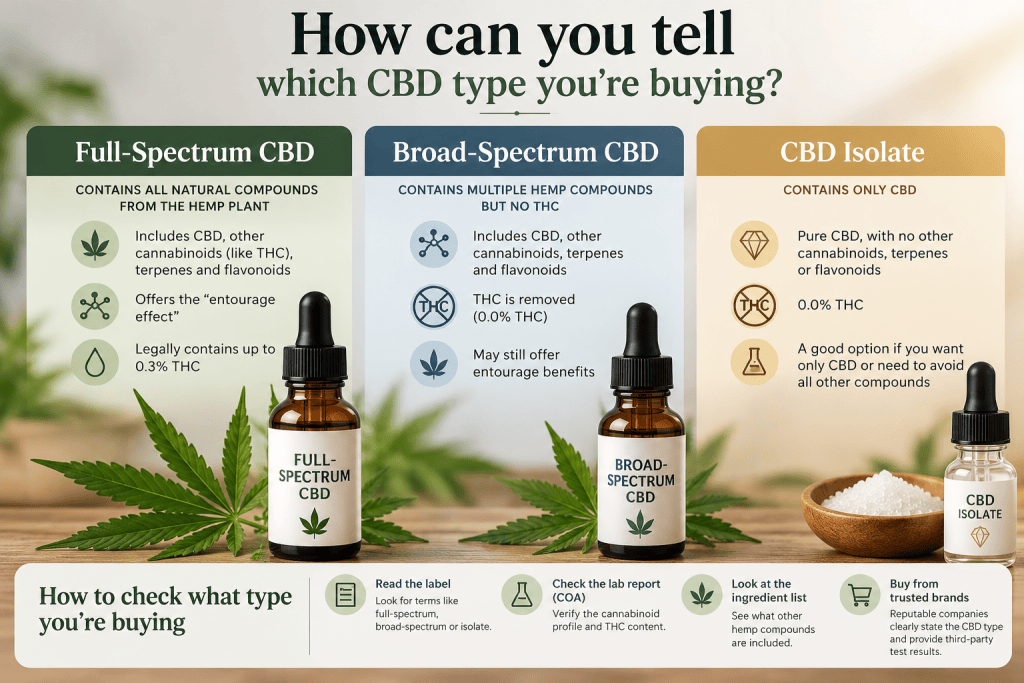
Check the lab report, not only the label. The words “full-spectrum,” “broad-spectrum” and “isolate” aren’t regulated terms, so a third-party COA is the only way to confirm what’s really in the bottle.
Here’s what to look for:
- Delta-9 THC and THCA lines. A number means THC is present. “ND” means it wasn’t detected. If you see a number, the product isn’t isolate and isn’t truly broad-spectrum.
- Total THC per container. Some reports list mg per unit. Compare that figure to the 0.4 mg cap.
- Other cannabinoids. CBG, CBN or CBC listed with numbers suggests a full or broad-spectrum extract. Only CBD with everything else ND points to isolate.
- Terpene results. Not every report tests for them, but if terpenes are listed, the product isn’t an isolate.
- A matching batch number and a recent date. An old report for a different batch tells you very little about the bottle in your hand.
If the label says THC-free CBD but the COA shows delta-9 THC with a number, trust the COA.
Where do our products fit?
Our own third-party COA library is the place to check each product line, and we’d rather show you the numbers than make claims the lab report doesn’t back up. You can open every report on our third-party COA and lab report page.
Our current lab reports list results by cannabinoid. They don’t use the words full-spectrum, broad-spectrum or isolate, so we don’t put those labels on our products either.
What the reports do show is useful. The current COA for our CBD tincture shows delta-9 THC detected alongside CBG, CBN and CBC. That means it isn’t an isolate or a THC-free CBD product. The CBD Tincture Oil comes in flavors including Apple, Guava, Mango, Peach, Strawberry and Blueberry, and it’s listed at $94.99.
As the December 11 date gets closer, we’ll update this page with any changes to our lineup and new lab reports.
Conclusion
Full-spectrum, broad-spectrum and isolate CBD all start from hemp. The difference after the ban is THC. Full-spectrum keeps trace THC, so most of it won’t fit under the 0.4 mg per container cap from December 11, 2026. Broad-spectrum and isolate products that test non-detect are the ones most likely to stay available.
Before your next order, open the lab report and check the THC lines yourself. You can browse our CBD tincture and other CBD products, and every product line links to its third-party COA. Our products are for adults 21 and older.
FAQs
Is broad-spectrum CBD completely THC-free?
Not always. Broad-spectrum CBD is processed to remove THC until a lab reports it as non-detect. That means THC is below the lab’s detection limit, not proven to be zero. Check the batch COA for delta-9 THC, THCA and total THC.
Which type of CBD will be legal after December 11, 2026?
Under the federal law as written, isolate and broad-spectrum products that test under 0.4 mg of total THC per container are the most likely to fit. Most full-spectrum products will exceed the cap. State rules can be stricter, and nothing here is guaranteed.
Can CBD isolate show up on a drug test?
No one can promise drug test results. Pure isolate shouldn’t contain THC, but products can be mislabeled or cross-contaminated during manufacturing. If drug testing matters for your job, read the COA closely and talk to your employer or doctor before using any hemp product.
Why is full-spectrum CBD affected the most?
Full-spectrum CBD contains THC on purpose. The new federal cap allows only 0.4 mg of total THC per container, while a 30-gram bottle at the old 0.3% limit could hold about 90 mg. Very few whole-plant extracts can meet the new cap.
What does “ND” mean on a CBD lab report?
ND stands for “non-detect.” It means the lab tested for a compound, such as delta-9 THC or THCA, and the amount was below what its equipment can measure. ND is a good sign for broad-spectrum and isolate products, but it isn’t proof of zero.